|
|
| Member of BannerPower Rotation System |
|
|
| Member of BannerPower Rotation System |
Flatland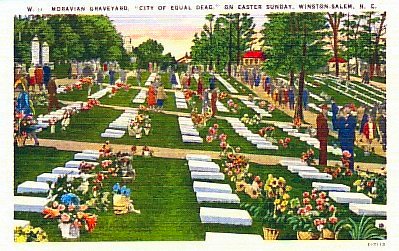 I have an old postcard, a linen, showing Winston-Salem's "City of Equal Dead". The tombstones lay flat, atop the ground, each identical to its neighbor except for the inscription and flowers. The Moravian sectionaries who built this sepulchral pasture want to impress on their members and outsiders that death comes to everyone and that everyone here, in life both rich and poor, shares the same classless state of existence. Most other Christian ministers (as well as rabbis and muezzins) preach the same message: what remains is the husk not the person and where the soul has gone, there is no social stratification -- as should be the case on Earth. Contemporary lawn cemeteries resemble the "City of Equal Dead": the stones are flush to the ground and the plots appear to be identical. Their wide greens, the bane of the monument-inspired taphophile, appear to grand equal dignity to all. What you see, however, is a subdivision where locations matters. There are plots for the rich and for the poor, or one should say for the extravagant and the thrifty (or "the cheap" as many grave-plot sales persons call them) because the rich and the educated often want the fewest frills in their funerals and burials. A lot with a good view commands top prices. In areas prone to flooding, the lots at the bottom of the hill are the least expensive because they are the most likely to get washed away. Some parts, like Southern California's Forest Lawn, have walled off sections where they bury the elite. If you want a plot close to a statue or attractive garden spot, you pay more. A famous person's grave can jack up mortuary property values in the adjacent lots. This says nothing of the fancy coffins, burial vaults, and other pricey kitsch under the ground. Equality of these dead is an illusion. Memorial parks exist to make money. The paths that allow mourners to visit graves without stepping on the tumuli of others have been eliminated: they eat up space that could be sold. The objective is to pack many bodies into an acre, to maximize profit. This table from Jessica Mitford's The American Way of Death Revisited shows a typical division of a cemetery property:
The conversion of some older graveyards into memorial parks results in some peculiar landscapes. The stately sepulchres and upright stones of old stand near the gate, suggesting to the passerby the peacefulness of the place and respect for tradition. In these areas, you find the most variety and originality because these graves were dug in a time when families did more than look over the products in a mortuary show room or select from a catalog: In those latter days of interment, the body was washed, dressed, and casketed in the home without embalming. Relatives came together to lay the deceased to rest, sometimes helping the sexton in the digging and the recovering of the hole. It wasn't a perfect world and it was difficult to keep the place, with all its trees, shrubs, and beds of flowers, looking good all the time. People built cemeteries over rolling hillsides, covered them with native plants, and sometimes even reused family plots over and over. They came often to see the dead, to cut the grass, paint the tombs. The grave was a true family heirloom, treasured and visited. Beyond the old sections lay the flatlands where odd spaces have been abolished and the monuments hidden an inch or so beneath the turf top. Families come here to leave flowers and get out of here before a security guard questions them. All that goes here must abide by the rules laid down by the management. A few make up for the sameness of the burial plots by installing a fancy brass plaque or laser etched stone. But standing at the edge of the flat section, one does not see the diversity nor does one get a sense of community spirit as one does in Winston-Salem. The sameness does not celebrate or ennoble: it denies dignity, converting a pretty field into a soul-less corpse yard. Taphophiles and consumer price advocates dislike memorial parks for pretty much the same reason: control is in the hands of the developer, not the family or the larger community. Burial regulations exist for the convenience of the cemetery management, a nonprofit corporation that is often merely a tax front for a land holding company. A few park owners are starting to take notice of the family desires to manage their own plots (see "Sloppy Kisses for the Dead"). Most, however, continue to insist that we manage our lives according to their own, undemocratic regulations. The industry does not do much in the way of providing for those of us who want a more natural setting for our final repose and it makes expressions of individual whimsy difficult. The order of the day is for an expensive funeral and elaborate preparations of the underground, with rules that leave consumers with little say over what appears on the surface. And, out here in California, that surface is but a few inches of green turf short of being a wind-blown dust lot. | ||||||||||
| Questions or Comments? |